Stopping Bissan's Seizures
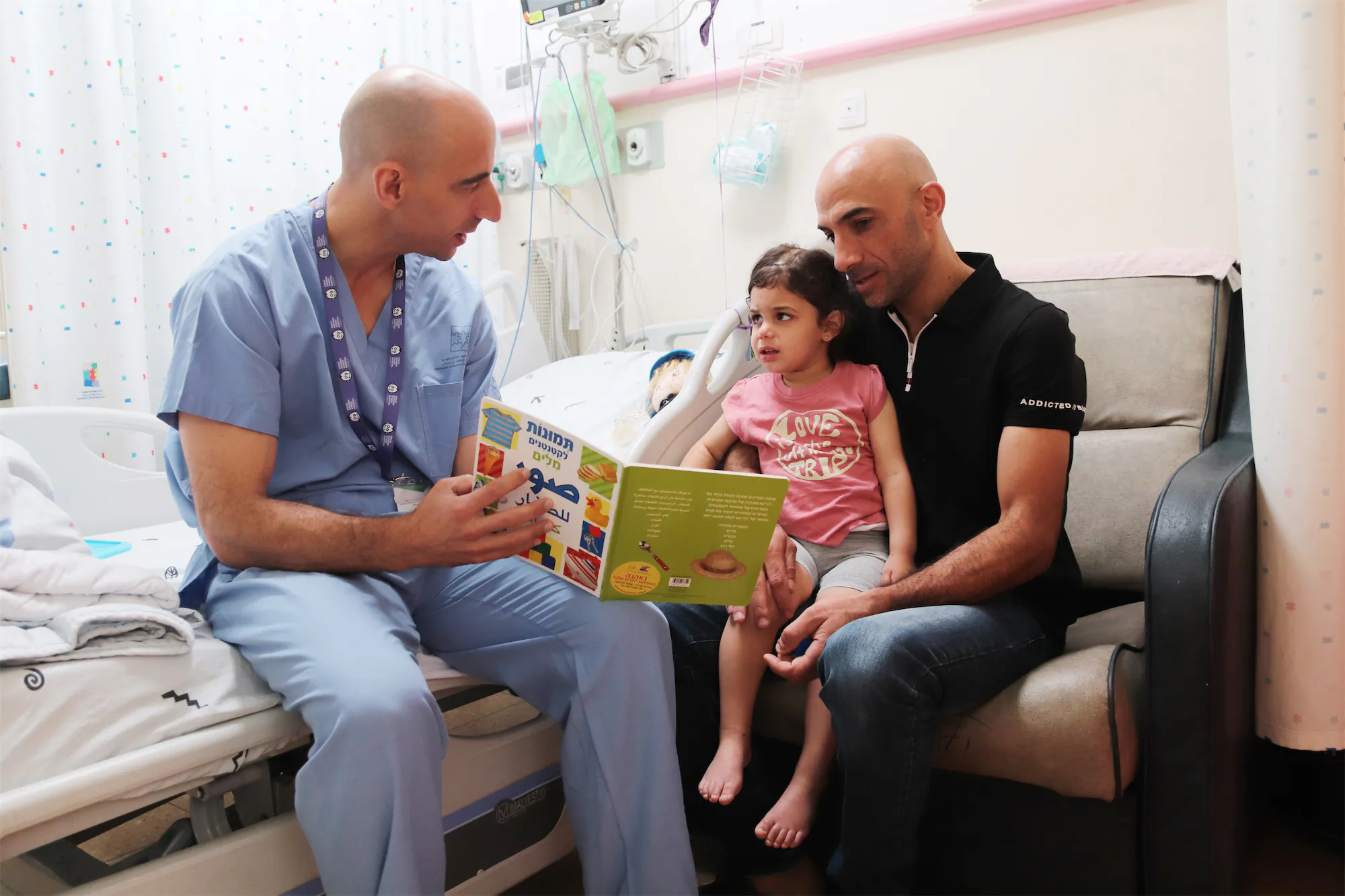
Bissan was born healthy. Genetic testing during her mother’s pregnancy was normal. Her birth was without complications. For the first few months, everything in the baby girl’s life seemed fine. There appeared to be some weakness on the left side of the baby girl’s body, but her parents assumed that would resolve on its own.
But then, at four months old, Bissan began to have seizures.
It started with spasms in her left hand. Next, convulsions spread across the entire left side of her body. Eventually, Bissan was completely paralyzed on her left side—and then seizures began on her right. After a series of tests, the diagnosis was confirmed: epilepsy, a chronic disorder in the electrical activity of the nerve cells in the brain. Worse still, Bissan suffered from a rare and severe form of epilepsy that didn't respond to medication.
During a seizure, normal communication between nerve cells is disrupted, causing uncontrolled bursts that affect thought, movement, and consciousness. About 90,000 people in Israel have epilepsy. Roughly one-third are resistant to medication.
Bissan's condition deteriorated. She was hospitalized, repeatedly. The seizures grew more frequent and more severe. Each one caused additional damage—to her development, her cognitive ability and her body.
The lives of Bissan’s parents revolved entirely around keeping their baby daughter safe. At home, they watched her around the clock. When she was hospitalized—which happened often, because her seizures were life-threatening—her mother and father took turns staying with her while the other managed work and their two older sons at home.
Doctors eventually concluded that surgery was Bissan's only option. They recommended hemispherectomy—a procedure in which the damaged hemisphere of the brain is disconnected from the healthy one to stop the seizures. It's one of the most complex operations in neurosurgery, rarely performed in Israel even on adults. It had never been performed on a child.
Six months ago, Bissan's parents met Dr. Ido Ben Zvi, head of epilepsy surgery at Schneider Children's Medical Center of Israel. Dr. Ben Zvi explained the risks. The surgery would require opening Bissan's skull. But without it, she would continue to lose cognitive function with every seizure.
"Dr. Zuabi, Bissan's doctor, told us that this operation was our only option," Bissan's mother, Rihan, said. "The doctor explained to us that Bissan was living with a ticking bomb in her head and the more the seizures occurred, the more her development would be delayed."
They went forward with the six-hour surgery.
"Bissan suffered from a rare syndrome that caused convulsions for which there was no medication. This operation—hemispherotomy—is performed only in cases where the entire hemisphere is involved in the seizure, making it impossible to remove just a portion,” said Dr. Zuabi. “During the surgery, we disconnect the electrical fibers that join the damaged hemisphere to the healthy half. In about 70% of cases, this stops the seizures altogether or significantly reduces their severity. This is an extremely complex procedure that requires the most precise anatomical knowledge."
Mere days after the surgery, Bissan’s seizures stopped completely
To reinforce the surgery's effect, Bissan was prescribed medication. Slowly, she was weaned off the medication. Bissan is now in a rehabilitation center at Beit Levenstein, working to regain motor function and cognitive skills damaged by years of uncontrolled seizures.
"Life before the operation was impossible,” said Rihan. “Since the surgery, she has not had one convulsion. This is truly an unbelievable miracle."
At Schneider Children's, pediatric neurosurgery is recommended when medication fails and the risks of doing nothing are greater than the risks of surgery.
The goal is always to give a child the chance at a normal, active life.
Moving Children Back to Their Wards After 40 Days in the Fortified Emergency Complex
In April 2026, as Iran launched ballistic missile attacks on Israel, Schneider Children's moved its patients into its fortified underground complex, where the hospital continued operating for 40 days. This video captures the moment the wards reopened and children were transferred back to their rooms, one by one, with their equipment and caregivers alongside them.
Protecting the Children: Roaring Lion
Filmed on February 28, 2026, at the onset of Operation Roaring Lion, this video captures Schneider Children's staff and volunteers calmly relocating patients to fortified floors as missiles struck, ensuring every child felt safe and every treatment continued without interruption.
Done, But Not Completed
In November 2023, following the October 7 attacks, Schneider Children's provided care to 19 children released from captivity, along with six mothers and two grandmothers. Faced with an unprecedented challenge and no clinical roadmap, a multidisciplinary team of physicians and mental health professionals developed an entirely new treatment protocol for child hostages returning from prolonged captivity. This video documents those first moments of return and the beginning of recovery.