In Death, He Gave Life
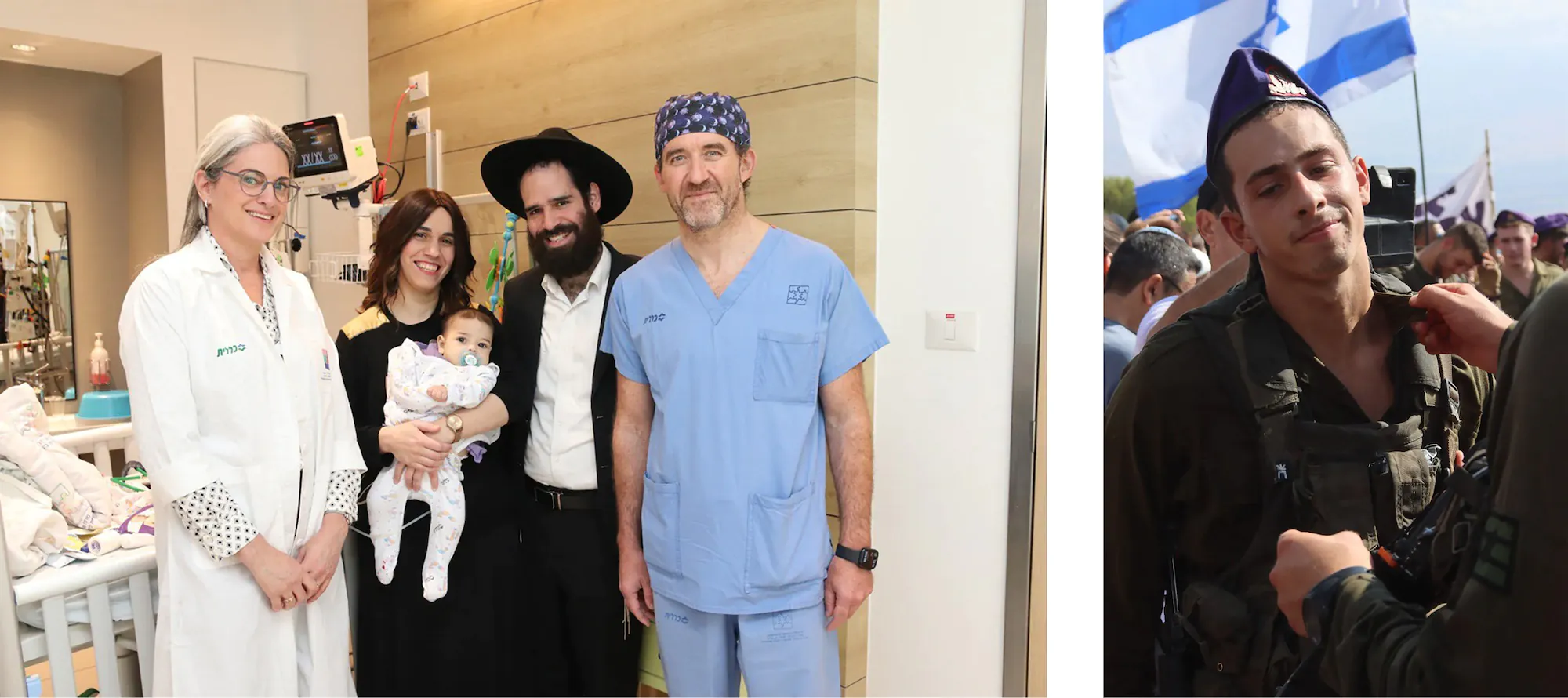
When Uri, a Givati commando, died of wounds sustained in Gaza, his family made a profound decision amidst their searing grief: to donate Uri’s organs.
Because of that selfless choice, two children at Schneider Children's Medical Center of Israel received organ transplants that saved their lives. Six-month-old Yitzhak received a portion of Uri's liver. A six-year-old girl received one of his kidneys.
When Yitzhak was three weeks old, he was diagnosed with biliary atresia, a rare disorder that affects roughly one in 15,000 infants. Biliary atresia blocks the bile ducts at birth or shortly thereafter, exerting pressure on the liver and causing an accumulation of scar tissue that can lead to cirrhosis or worse—liver failure.
After this diagnosis, Yitzhak underwent a Kasai procedure during which a renewed connection was created for the bile ducts. Unfortunately, Yitzhak’s condition continued to deteriorate. His parents frequently brought him to the hospital.
It soon became clear that only a transplant could save Yitzhak’s life.
Yitzhak's father, Yaacov, had been preparing to donate part of his liver. But in a medical twist of fate, moments before Yaacov and Yitzhak, then six months old, were scheduled to arrive at the hospital for the operation, the family received a call: a donor liver was available.
The surgery began at Soroka Hospital in Beersheva. There, Uri’s liver was removed. From Saroka, the liver was transported to Schneider Children's where Yitzhak was prepped for surgery. Since its founding, Schneider Children's has performed more than 700 pediatric transplants—heart, lung, liver, kidney—with outcomes that match the best pediatric centers in the world.
“When Schneider called us with the news that a donation had been found for Yitzhak, we were told to arrive immediately,” said Yaacov. “My parents had heard that same day that a soldier named Uri had been killed in Gaza, and that his mother said in an interview that he had donated his organs, including a liver lobe for a six-month-old infant. We understood that he was the donor for our son. Of course, we contacted the mother at once and thanked her.”
Yitzhak’s six-hour-long liver transplantation was a success. He was transferred to the intensive care unit and then to the pediatric ward where he continued his road to recovery.
“I think that this war has taught us to put all arguments aside and see the unity and sharing,” said Yaacov. “In the end, we are all one people, and here at Schneider, it is so apparent—saving lives crosses all sectors and creeds. We are deeply grateful for the donation we received."
“During his life, Uri always looked first at others and only afterwards at himself, and therefore I feel that his donation typifies him totally,” said Naomi, Uri’s beloved mother. “There are those whose deaths are final, but for us, there is great comfort in the fact that because of Uri, children's lives were saved."
Dr. Michael Gurewitz, Head of the Liver Transplantation Unit at Schneider Children's will remember that experience forever.
"There are no words to describe what the operating room staff felt in such a moment,” he said.
“The knowledge that a soldier saved lives by giving his own life stays with you,” Gurewitz continued. “While the country battles for our home, we are busy saving the life of a child. We acknowledge the privilege given us to save lives. Each child is an entire world."
Moving Children Back to Their Wards After 40 Days in the Fortified Emergency Complex
In April 2026, as Iran launched ballistic missile attacks on Israel, Schneider Children's moved its patients into its fortified underground complex, where the hospital continued operating for 40 days. This video captures the moment the wards reopened and children were transferred back to their rooms, one by one, with their equipment and caregivers alongside them.
Protecting the Children: Roaring Lion
Filmed on February 28, 2026, at the onset of Operation Roaring Lion, this video captures Schneider Children's staff and volunteers calmly relocating patients to fortified floors as missiles struck, ensuring every child felt safe and every treatment continued without interruption.
Done, But Not Completed
In November 2023, following the October 7 attacks, Schneider Children's provided care to 19 children released from captivity, along with six mothers and two grandmothers. Faced with an unprecedented challenge and no clinical roadmap, a multidisciplinary team of physicians and mental health professionals developed an entirely new treatment protocol for child hostages returning from prolonged captivity. This video documents those first moments of return and the beginning of recovery.